Signature Verification
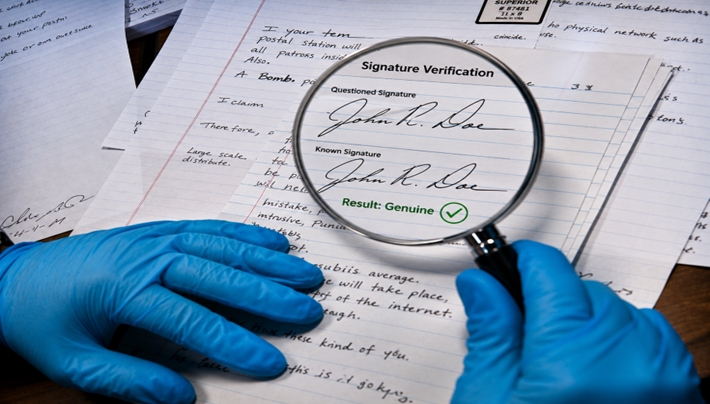
Signature
verification is a forensic process used to determine the authenticity of a
person’s signature by examining and comparing its distinctive characteristics.
Since every individual develops unique signing habits over time, signatures
serve as an important means of personal identification in legal, financial, and
official documents. Forensic experts analyze signatures to identify genuine
writings, detect forged signatures, and establish authorship in disputed cases.
During
examination, experts study various features such as pen pressure, stroke
formation, slant, speed, rhythm, spacing, alignment, connecting strokes, and
signature movement. Genuine signatures generally show natural consistency,
while forged signatures often display signs of hesitation, tremors, unnatural
pen lifts, or inconsistent writing patterns. Advanced forensic tools such as
microscopes, digital imaging systems, and handwriting comparison software are
commonly used to improve accuracy and reliability.
Signature
verification is widely used in several areas, including:
·
Banking and cheque fraud investigations
·
Verification of legal and financial documents
·
Detection of forged signatures
·
Authentication of contracts, agreements, and
wills
·
Insurance and property dispute investigations
·
Employee and identity verification processes
·
Court evidence examination and legal
proceedings
·
Verification of official government records
Because
signatures are legally recognized forms of personal authentication, signature
verification plays a crucial role in preventing fraud, protecting document
integrity, and supporting forensic investigations.